
Memory is not a folder

EverdreamSoft
Notes on building long-term memory for AI agents — why the storage metaphor is wrong, and what spreading activation buys you.
When engineers think about memory, the first metaphor that arrives is the folder. A place where things are put, and from which they are retrieved. Files, directories, contents. It is the metaphor of the mainframe, of the desktop, and — barely disguised — of every vector store currently sold as "AI memory": you embed a chunk of text, you index it, and when you need to recall something you project the query into the same vector space and pull back its neighbors.
This metaphor is broken. Not technically — it works, often well — but conceptually. Real memory is not a folder. We do not remember by searching; we remember by recognizing. Mention a wedding to a friend and watch what happens: their attention does not parse a mental index of "events / ceremonies / social". Something far older and far faster lights up — a network of associations that brings, in one movement, the last wedding they attended, who got married, what was served, who they met, the photographs, the in-laws. Not a result set. A region of mind suddenly available.
Three thinkers — one logician, one neuropsychologist, and one storyteller — give us, between them, almost everything we need to build memory correctly for AI agents.
Frege: identity holds when description varies
In 1892, Gottlob Frege published a short paper called Über Sinn und Bedeutung — On Sense and Reference. He noticed something simple and deep: Hesperus and Phosphorus, the morning star and the evening star, both refer to Venus. They have the same reference (Bedeutung). But "Hesperus is Phosphorus" is informative in a way "Hesperus is Hesperus" is not. The two names present the same object through different senses (Sinn) — different cognitive paths to the same referent.
This distinction is exactly what every vector store collapses. Embed "the user", "the principal", "the customer", "the visitor", and four slightly different descriptions of the same person and you get four slightly different vectors. Cosine similarity does its best, but it cannot tell you that these are the same person described differently. It only tells you that these descriptions are similar. The distinction matters.
A useful AI memory must preserve identity under variation of description. Take a concept everyone agrees on: the sun.
Concept(sun)
  ─ contained_in → egyptian_mythology   refs: { name: "Ra", attribute: "sun-god" }
  ─ contained_in → greek_mythology      refs: { name: "Helios", chariot: "golden" }
  ─ contained_in → modern_astronomy     refs: { name: "Sol", radius_km: 696340, type: "G2V" }
One referent. Three very different elaborations. A graph DB with stable concept IDs preserves the identity (Concept(sun) has one ID across all three triplets) and lets each source attach its own attributes. A vector store would fold them into adjacent points and lose the structure. A classical graph DB with free-form labels could connect them, but no LLM could read the vocabulary. That is the property Frege named — the property a memory layer for agents must implement: invariance of reference under variation of sense.
Hebb and Collins-Loftus: the mechanism is propagation
If Frege gives us the logic, the neurologists give us the mechanism. Donald Hebb, in The Organization of Behavior (1949), wrote a hypothesis that has never been refuted:
When an axon of cell A is near enough to excite cell B and repeatedly or persistently takes part in firing it, some growth process or metabolic change takes place in one or both cells such that A's efficiency, as one of the cells firing B, is increased.
Carla Shatz boiled it down in 1992: neurons that fire together, wire together. Memory is not stored. It is wired. Co-occurrence strengthens the path. Repetition is reinforcement.
Twenty-six years after Hebb, Allan Collins and Elizabeth Loftus published A Spreading-Activation Theory of Semantic Processing (1975). Their model: the semantic memory of a human being is a graph of nodes connected by weighted edges. Recalling a concept means activating the node and letting the activation propagate, with strength decaying as it travels. The word doctor primes nurse and hospital faster than saucepan because the edges are shorter and heavier.
Half a century later, the model still holds. Every priming experiment, every lexical-decision study, every reaction-time finding in psycholinguistics rests on it. It survived because it does not describe a particular theory but a geometry: memory is a graph, recall is propagation.
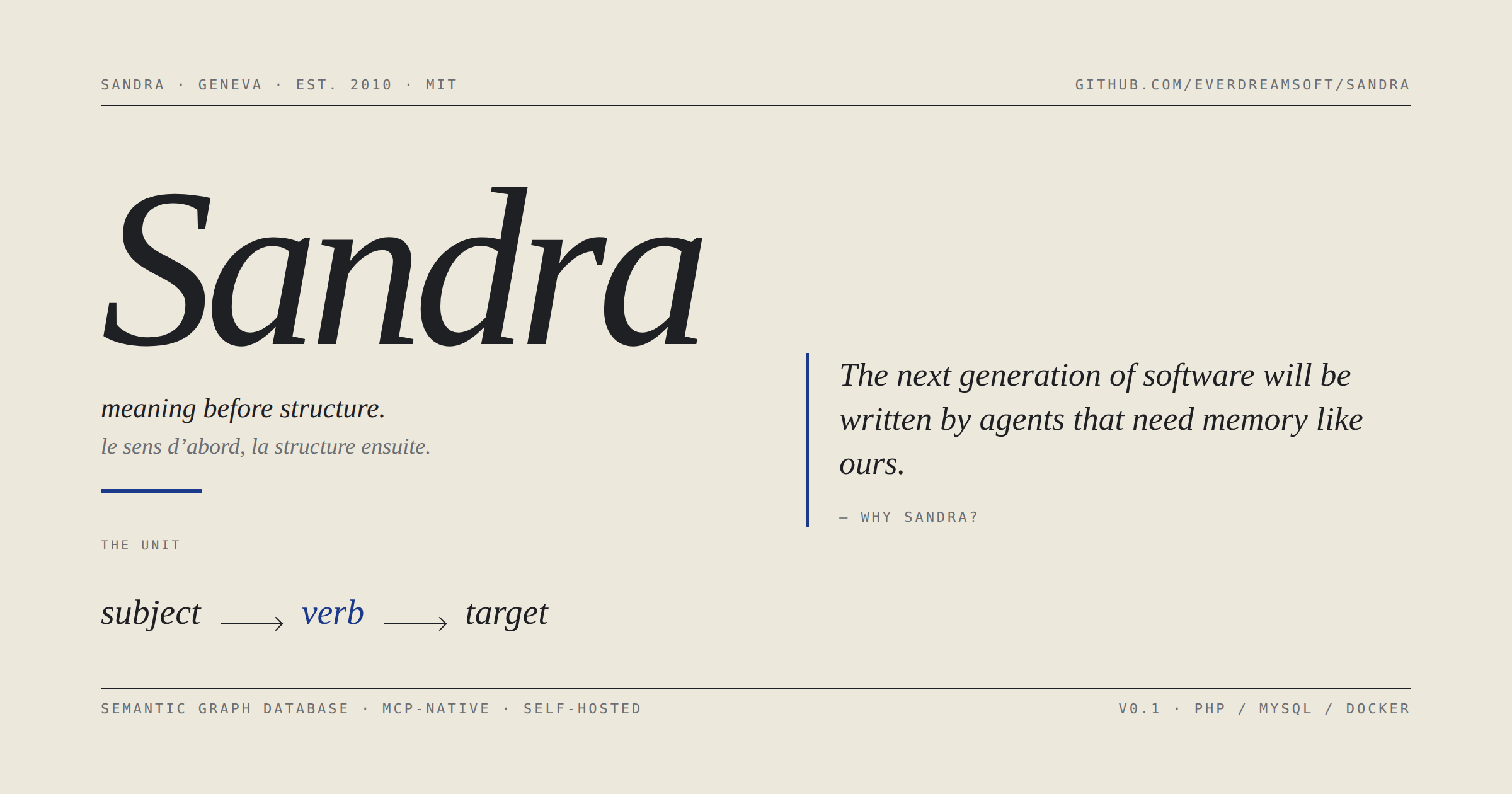
When Sandra represents the memory of an agent as a set of triplets (subject, verb, target), this is not metaphor. A concept is a node. A triplet is a synapse. A query is a propagating activation. When the agent encounters Alice, Sandra returns in one walk everything that identity has wired: likes → strawberry, works_with → Bob, married_to → Marie. That is the activation gradient of Collins and Loftus, made deterministic and traceable. That is also Hebbian wiring, made explicit: every triplet you create is a synapse you placed; every triplet you delete is a synapse you removed. Forgetting becomes a function, not an accident.
Funes: what total memory destroys
In 1942 Jorge Luis Borges wrote a short story called Funes el memorioso. A young Uruguayan man falls from a horse and discovers, on recovering, that he can no longer forget anything. He remembers every leaf of every tree of every forest, and every time he has perceived or imagined that leaf. The story is short. The line that should haunt every builder of AI memory is this:
Pensar es olvidar diferencias, es generalizar, abstraer. To think is to forget differences, is to generalize, to abstract.
Funes does not think. He records. He is the technical hell of a system that forgets nothing: no compression, no salience, no generalization. Everything kept, nothing recoverable as meaning.
This is the warning against the maximalist instinct in vector-store marketing — we will index everything, we will retrieve everything. A useful memory is not defined by what it retains. It is defined by its capacity to bring up, at the right moment, the right associations. The quality criterion is not exhaustive recall. It is activation relevance. And activation relevance requires structure — the explicit edges Funes lacked, the typed graph that lets a planner decide which neighbors fire and which stay quiet.
The shared cortex
There is one more move. The Western mnemonic tradition — the method of loci of Cicero, the memory palaces of the Renaissance, the giant visual systems of Giulio Camillo — produces an exquisite memory that cannot be shared. Cicero's palace is legible only by Cicero. Matteo Ricci's palace is legible only by Ricci. The art of memory is a solitary craft.
Maurice Halbwachs, in Les Cadres sociaux de la mémoire (1925), proposed a quiet revolution: individual memory never exists in isolation. It is always already framed by collective structures — families, professions, languages, institutions. We do not remember alone.
This intuition becomes urgent now, at the moment we are building artificial minds. If every agent must construct its own private palace — its own vocabulary, its own encoding, its own store — then no agent can collaborate with another. Each LLM rewrites Combray in its own way, and none can hear another's madeleine.
The interesting design question for AI memory is therefore not "how big can the store be?" or "how fast is the retrieval?" but whether the substrate is shared. A graph with stable, named, public concept IDs is shared by construction. Any agent that calls list_concepts reads the vocabulary; any agent that creates a triplet contributes a synapse readable by every other. The palace becomes a city.
Coda
The thread that ties Frege, Hebb, Collins-Loftus, Borges, and Halbwachs together can be stated simply: useful memory is not the archive of the past, it is the disposition to recognize. Recognition means activating the right neighborhood, from the right entry point, at the right moment, with the right damping.
Building memory for agents is therefore not a storage-engineering problem. It is a form-of-substrate problem. The right form, in my view, is a graph of named concepts wired by explicit, typed synapses, on top of which a planner — the LLM, the agent, sometimes an indexer — decides what to activate, what to leave dormant, what to compress, what to forget.
Sandra is an experiment in that direction. It is not the only possible answer. But it is one shape that takes Frege's logic, Hebb's mechanism, Borges's warning, and Halbwachs's social intuition seriously, and refuses the folder.
References
Gottlob Frege, "Über Sinn und Bedeutung", in Zeitschrift für Philosophie und philosophische Kritik C, 1892 (In English: "On Sense and Reference", alternatively translated, in later edition, as "On Sense and Meaning")
Donald Olding Hebb, The Organization of Behavior : A Neuropsychological Theory, Wiley, New York, 1949
Carla J. Shatz, "The Developing Brain", Scientific American, United States, 1992, p. 60–67
Allan M. Collins, Allan M.; Elizabeth F. Loftus (1975). "A spreading-activation theory of semantic processing". Psychological Review. 82 (6): 407–428
Jorge Luis Borges, Funes el memorioso
Maurice Halbwachs, Les Cadres sociaux de la mémoire, Paris, Albin Michel, coll. "L'Évolution de l'Humanité", 1994 (1925)